Ready to Bring Your Game to Life?
Share your game idea with our team and get a detailed roadmap to turn it into reality.
You have an NFT game concept that proves to be the next Axie Infinity or Gods Unchained? That’s exciting! But there is one question that is torturing you at night before you leap into the development: How much does NFT game development cost?”
The thing is that the development of NFT games cannot be compared to the development of a usual mobile game. You are dealing with blockchain integration, smart contracts, digital wallets, the ability to market, and an ecosystem as a whole, and it needs to work perfectly. Any wrong step can be disastrous in security terms, or a clumsy interface that will send gamers away.
The question of cost is also not easy. I’ve seen founders receive estimates ranging from $50,000 to over $500,000 for projects that, at first glance, seemed very similar. Confusing, right?
That’s exactly why you need this guide: to understand what actually drives NFT game development costs, where your money goes, and how to budget smartly without compromising on the quality that’ll make your game stand out in this competitive market.
Before getting into the realm of blockchain games, one should first learn what NFT games are even about. NFT games are video games that rely on blockchain technology, which enables players to literally own their in-game items and assets.
The term NFT is an abbreviation that means Non-Fungible Token, a type of special digital certificate that allows you to own a particular object, i.e., characters, weapons, or even skins.
NFT games will give you physical ownership, unlike conventional games, where the company retains ownership of all the items, and you can sell, trade, or store these items even when the game goes out of business.
The most interesting aspect of such games is the play-to-earn business model, which allows players to earn real money by collecting rare in-game items and buying and selling within the game economy.
In case you want to develop your own mobile game, then collaborating with an established NFT Game Development Company will assist you in developing an interactive and lucrative gaming experience for the players.
The NFT gaming market is in its boom, and 2026 is the right moment to invest. Here’s why:
The NFT game development cost depends on complexity, features, and platform. Here’s an overview of average development costs across different types of NFT games:
| NFT Game Type | Average Cost Range | Description |
| Basic NFT Game | $50,000 – $100,000+ | Simple gameplay with minimal features and basic blockchain integration. |
| Mid-Level Blockchain Game | $100,000 – $300,000+ | Moderate complexity, enhanced graphics, and NFT/crypto features. |
| High-End / Cross-Platform Game | $300,000 – $500,000+ | Cross-platform support, advanced features, and immersive gameplay. |
| Large AAA / Metaverse-Style Project | $500,000 – $1M+ | Extensive features, large-scale user base, fully immersive worlds, and complex blockchain systems. |
Note: Some initial projects can start as low as $35,000–$40,000 for basic iOS or Android games, but costs rise quickly with advanced features. To get an accurate estimate, it’s better to collaborate with a mobile game development company experienced in NFT and blockchain games.
Share your game idea with our team and receive a detailed, custom quote tailored to your project.
The cost breakdown of game development will allow you to make sound decisions regarding where to spend money and where to save it. The following is a closer examination of each element:
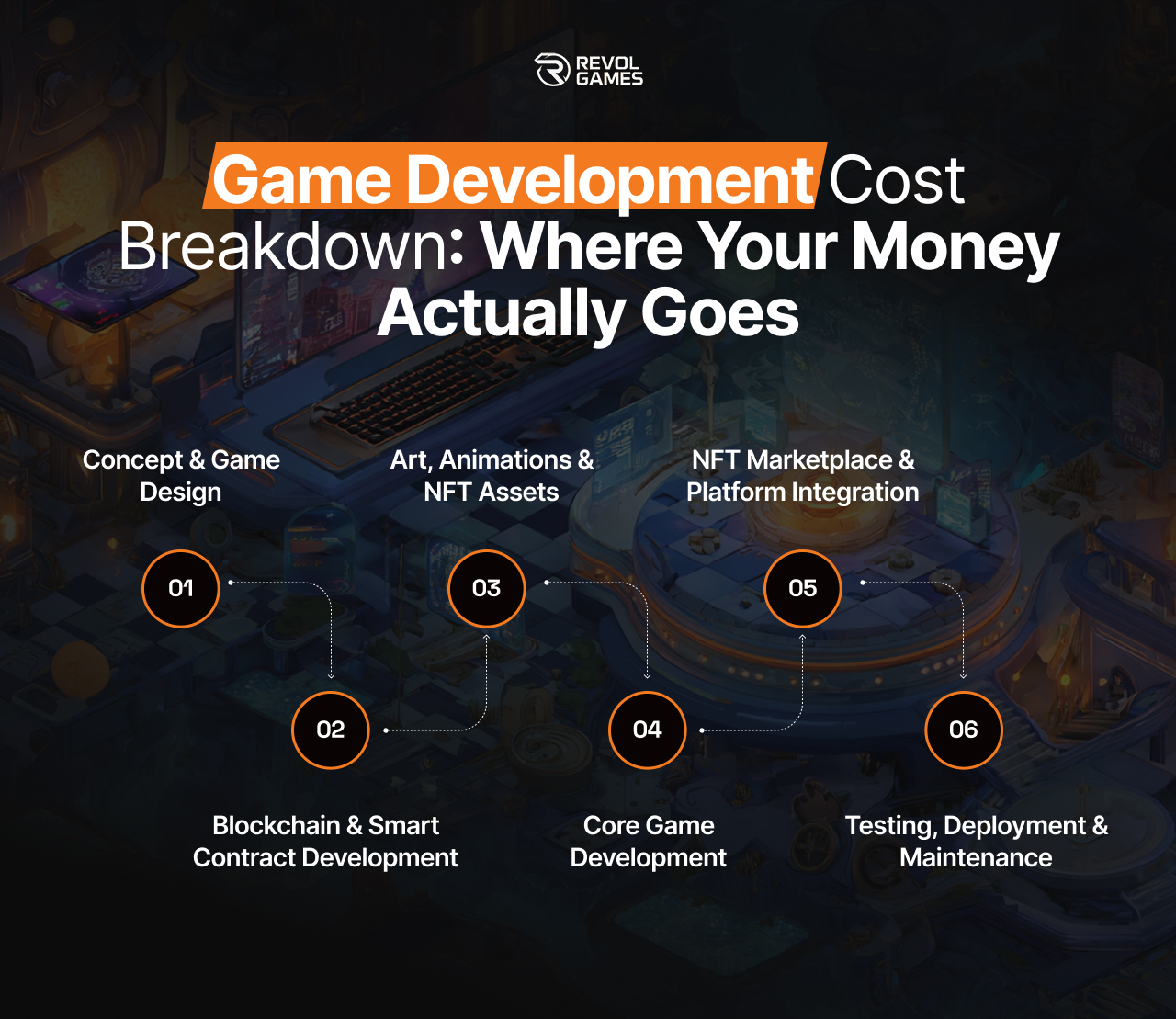
Estimated Cost: $5,000 – $30,000
Any popular NFT game is based on a good idea. This stage includes:
An effective design phase ensures the game is interactive and aligned with the expectations of your target audience.
Estimated Cost: $10,000 – $50,000
The NFT games are based on blockchain integration. Key steps include:
This is one of the most critical aspects in the game development cost breakdown, since experienced blockchain developers are required.
Estimated Cost: $8,000 – $50,000
The possession of unique and visually amazing resources can make your game special. This phase covers:
Estimated Cost: $30,000 – $250,000
To transform designs into a game to play entails:
Estimated Cost: $10,000 – $100,000
A functional NFT marketplace is essential for trading in-game assets. Tasks include:
Marketplace integration not only adds value but also monetization potential for your game.
Estimated Cost: $5,000 – $30,000 + ongoing 10–20% of initial budget annually
A fine game needs extensive testing and constant support:
Constant maintenance retains players in the long run and facilitates transactions of the NFTs.
Developing an NFT game is not similar to the development of a standard mobile application. It is a kind of entertainment mixed with financial technology, forming the digital economies, and by providing the players with real ownership of the in-game items.
This rare mix of factors makes budgeting for NFT game development challenging yet essential.
Start with your vision. Do you want to create the easiest card-trading game or an all-encompassing metaverse environment? The size of your project determines the basis of all other factors. Games whose content is procedurally generated, with dynamic environments and persistent worlds, require exponentially greater resources.
Think not only about the first release, but also about your roadmap. Do you release with minimum features and add, or release with an experience-complete feature set? Phased development has the advantage of spreading the costs over time, but necessitates proper architectural planning in the initial planning phase.
The technology stack that you use dictates short-term and long-term costs. The decision of developing on Ethereum, Polygon, Solana, or new Layer-2 solutions will influence the complexity of development, costs, and user experience.
Budgets are also affected by the decision to create their own smart contracts or resort to some established NFT standards (such as ERC-721 or ERC-1155). Custom solutions are flexible and need a lot of security audits. The industry-standard protocols are time-efficient, but can restrict original gameplay.
Contrary to other types of games, NFT games need a working economy from the very beginning. The ability to design tokenomics, i.e., how players can earn, spend, and trade, requires knowledge of game theory, economics, and blockchain mechanics. Will you apply a single- or a two-token economy? What will you do to avoid inflation or manipulation?
These systems are difficult to build and balance without specific knowledge beyond normal game development. You will require economic modeling, simulation testing, and maybe external audits so that it is sustainable.
The selection of blockchain influences the cost and performance. Ethereum has a high ecosystem, yet it has a higher gas charge, whereas Polygon and Solana are cheaper and quicker.
The development of smart contracts may cost between 15,000 and 60,000 dollars, and basic security audits may cost between 10,000 and 40,000 dollars.
Partnering with a reputable blockchain development services provider will guarantee the safety and effectiveness of smart contracts and the effective integration of NFTs.
Blockchain interactions are complex. The most successful NFT games conceal this complexity with user-friendly interfaces. To introduce a smooth wallet integration, streamline transaction processes, and distinct ownership presentations, it takes a heavy investment in UX/UI.
Additional options, such as gasless transactions (meta-transactions), the ability to socially log in, or a custodial wallet solution, offer ease of access but introduce layers of development. The easier you make the experience of non-crypto users, the greater the initial investment.
NFT games require plenty of assets. You are making 10,000 different profile pictures or hundreds of gameplay items: each of them requires art, metadata, assigning rarity, and combining smart contracts. Tools that can be used are procedural generation, although it takes talented artists and proper curation.
3D characters, animation, sound design, and visual effects increase the cost of production. The distinction between simple 2D sprites and high-resolution, fully-rigged 3D characters with custom animations might indicate tens of thousands of dollars per category of assets.
Unlike traditional games, NFT games need a powerful backend infrastructure. In addition to game servers, developers must handle blockchain event tracking, NFT ownership indexing, off-chain gameplay logic, and node management. Metadata, IPFS, and CDN services of media assets are all storage solutions that contribute to the cost of operation.
Multiplayer features in real-time require a very low and high-performance multiplayer server infrastructure in terms of latency and reliability. These recurrent costs are to be taken into consideration with the NFT game development costs.
There are special testing problems with blockchain integration. Smart contracts have to be audited strictly; failure to audit can result in irreparable loss of assets of the players. Functional testing, security audits, testing of economic simulation, and stress testing under different network conditions will be required.
The cost of professional smart contract audits is likely to range between $15,000 and and$100,0000 or even higher based on the level of complexity.
NFT games exist in changing regulatory environments. Legal counseling assists in organizing your project to be in line with the securities laws, gambling laws, tax laws, and data protection laws in the various jurisdictions. Legal expertise is needed in terms of service, privacy policies, and protection of intellectual property.
Certain areas have certain limitations on blockchain games or NFTs. Learning about these constraints and making plans to avoid them allows one to avoid costly mistakes in the future.
Effective NFT games require active communities before implementation. Community building, such as creating a Discord server, managing social media, and offering early access or companion NFTs, requires resources outside the core game development process.
Numerous projects will spend 20-30 percent of their overall budget on marketing and community building, which is essential to create the base of initial players that will ensure the viability of NFT economies.
Share your game concept with us and watch it come to life with expert guidance from RevolGames.
If you’re building a mobile NFT game, this mobile app game development cost adds another layer of considerations:
The development of a mobile game can cost between $15,000 to create a simple 2D casual game, and up to $300,000 and above to create a premium 3D or multiplayer experience. Include blockchain integration, and you are adding 30-50% to those numbers.
Picking the right game engine affects your budget more than you might think. Let’s break down the two most popular choices and see which one fits your wallet better.
| Feature | Unity | Unreal Engine |
| Learning Curve | Easy to moderate | Steep |
| Development cost | $30,000 – $80,000 | $50,000 – $150,000 |
| Graphics Quality | Good | Excellent |
| NFT Tools Available | Many plugins & templates | Growing ecosystem |
| Best For | 2D games, mobile, indie projects | High-end 3D, AAA-quality games |
| Team Experience Needed | Junior to mid-level | Senior developers |
| Community Support | Massive | Strong but smaller |
Building an NFT game is exciting, but there are hidden costs beyond development that every founder should plan for.
NFT games involve real money and other decision-making involving digital assets, meaning legal protection is necessary. These involve writing terms of service, privacy policies, protection of intellectual property, and compliance with KYC/AML requirements. Failure to do this may result in fines or even greater issues in the future.
There is a great community that can either build or destroy an NFT game. Invest in social media promotion, Discord and Telegram administration, collaboration with influencers, and events to ensure that players remain active. The intensive use of launch campaigns is particularly needed to achieve initial momentum.
Blockchain expenses are easy to get away with. It involves NFT minting and deployment of a smart contract, mainnet testing, and transaction charges. The prices differ according to blockchain and the quantity of NFTs.
The majority of NFT games depend on external systems such as analytics, cloud backend, push notifications, and customer support services. These are recurring costs, which are minor but critical to running.
In the case of mobile NFT games, both Apple and Google Play stores charge in-app purchases at a 30% rate. Although this has no impact on the NFT sales in the external marketplaces, it should be considered in your pricing.
Building an NFT game doesn’t have to drain your bank account. There are smart ways to save money while still creating something great. Here’s how to do it.
Do not attempt to give everything at once. Start with the bare minimum: a simple game, a limited inventory of 50-100 NFTs, a single blockchain, and a simple marketplace. This will reduce your expenses to approximately half. You can always later add additional features depending on what your players really want.
Take game engines such as Unity or Unreal Engine that have already been tested. In case of the blockchain stuff, it is better to use such tools as Thirdweb or Moralis, which simplify everything. It also has ready-made templates of NFT contracts and markets. This would save you a figure of about 20,000 to 50,000 dollars, as you are not starting at zero.
There are plenty of good graphics, sound, and other parts of the game available for sale online. Unity Asset Store, Unreal Marketplace, and OpenGameArt.org are some of the places where you can find them all. Only draw original art to those parts that are different in your game. This will save you 10,000-30,000 on art alone.
Your choices of blockchain have a massive impact on your expenses. Polygon is free and is already used by many people. Immutable lets you create NFTs with no fee and includes a marketplace. This will save you $5,000 to to$15,0000 of testing and launch expenses on a less expensive blockchain.
Make your game one step at a time rather than as a whole. Create an empty game with no crypto in it first. When that is performing well, then add the wallet connection. Next, add NFT features, then finally construct the marketplace. In doing so, when something does fail, you would have noticed it earlier when it is cheap and simple to rectify.
Now that you understand the real costs behind NFT game development, the crucial next step is finding the right partner to turn your vision into reality.
RevolGames is a leading name in the NFT gaming space, offering complete NFT Game Development Services from initial concept through post-launch growth. With a track record of successful launches and deep expertise in both Web3 and gaming, Revol Games helps founders avoid the hidden costs and technical pitfalls that derail most NFT game projects.
Our end-to-end service will ensure you only deal with one team that has the experience and skills to manage many vendors, minimize miscommunication is minimized and your project will be on track and on budget.
The cost of developing an NFT or crypto game can range from $50,000 for simple games to over $1 million for advanced, feature-rich projects. Prices vary depending on the game’s complexity, graphics, features, and the blockchain integration required.
Yes, NFT games offer opportunities for ongoing revenue via trading, purchases, and special events. Still, actual profits fluctuate with player activity, game popularity, and the demand for digital assets.
Building an NFT game isn’t quick; it can take anywhere from half a year to over two years, depending on the game’s complexity.
Absolutely. Many NFT games are designed for iOS and Android, allowing players to access NFTs and in-game assets directly from their mobile devices.
Yes, collaborating with an experienced game app development company is highly recommended for NFT games. They bring expertise in blockchain integration, smart contracts, and seamless game design.
The best part about making a Unity game is that, for indie developers, small and large gaming companies, they need…
So, you’ve got a brilliant game idea, but now comes the question that stops most developers in their tracks: do…
You have an NFT game concept that proves to be the next Axie Infinity or Gods Unchained? That’s exciting! But…