![Unreal Engine vs Unity [Which is Better for Game Development in 2025]](https://revolgames.s3.us-east-1.amazonaws.com/assets/gemini-2-5-flash-image_generate_images_on_this_title_Unreal_Engine_vs_Unity_Which_is_Better_for_Game_De-0-1763653895-4162.jpg)
The debate over the top game development engines never truly ends. For years, the choice has often been between two industry giants – Unreal Engine vs Unity. Now, with both game development platforms getting major upgrades in 2025, the selection becomes more critical than ever.
You are impressed with the stunning photorealism of Unreal Engine 5.4. Then someone talked about the ease, compatibility, and mobile market dominance of Unity 6. In such scenarios, deciding “which engine should you choose for your next project” depends entirely on your team’s size and your final visual goals.
This guide cuts through the noise. We provide a detailed comparison of Unreal Engine vs Unity for 2025, covering their performance, pricing, and learning curve. Moreover, we also look into the latest features of Unity 6 and Unreal Engine 5.5 to show you exactly which tool will help you succeed with your vision.
Unreal Engine vs Unity At Glance
Short on time? Here’s the quick Unity vs Unreal Engine comparison that covers all the basics you need to know.
| Feature | Unity | Unreal Engine |
| Primary Language | C# (Easier to learn) | C++ & Blueprints (More complex) |
| Graphics Focus | Versatile, great for performance on all platforms (URP, HDRP) | High-End Photorealism (Nanite, Lumen) |
| Best For | Mobile, Indie Games, AR/VR | AAA, PC/Console, Cinematic Experiences |
| Pricing Model | Subscription-based (Free up to $200K revenue) | Royalty-based (Free up to $1M revenue) |
Unreal Engine vs Unity: Market Share and Popularity
Market share clearly indicates where each engine currently dominates. Unity holds the highest market share for mobile game development in terms of volume.
The 2024 Unity Gaming Report mentioned that 71% of the top 1000 mobile games were built with the Unity engine. Besides mobile, the engine also dominates indie and 2D markets.
Unreal Engine holds a smaller overall share but dominates the high-budget end of the market. While its game count is lower, the games built on Unreal often generate higher revenue per title.
Sensor Tower highlights that in 2024, Unreal Engine games accounted for 31% of units sold on Steam, surpassing Unity’s 26% share.
The Unreal Engine vs Unity market share difference shows Unity has the breadth, but Unreal has the financial depth.
The Gap Between Unreal Engine and Unity Is Narrowing
RevolGames helps you choose the right engine for your next big release — balancing performance, scalability, and creative freedom.
Unity Engine Overview
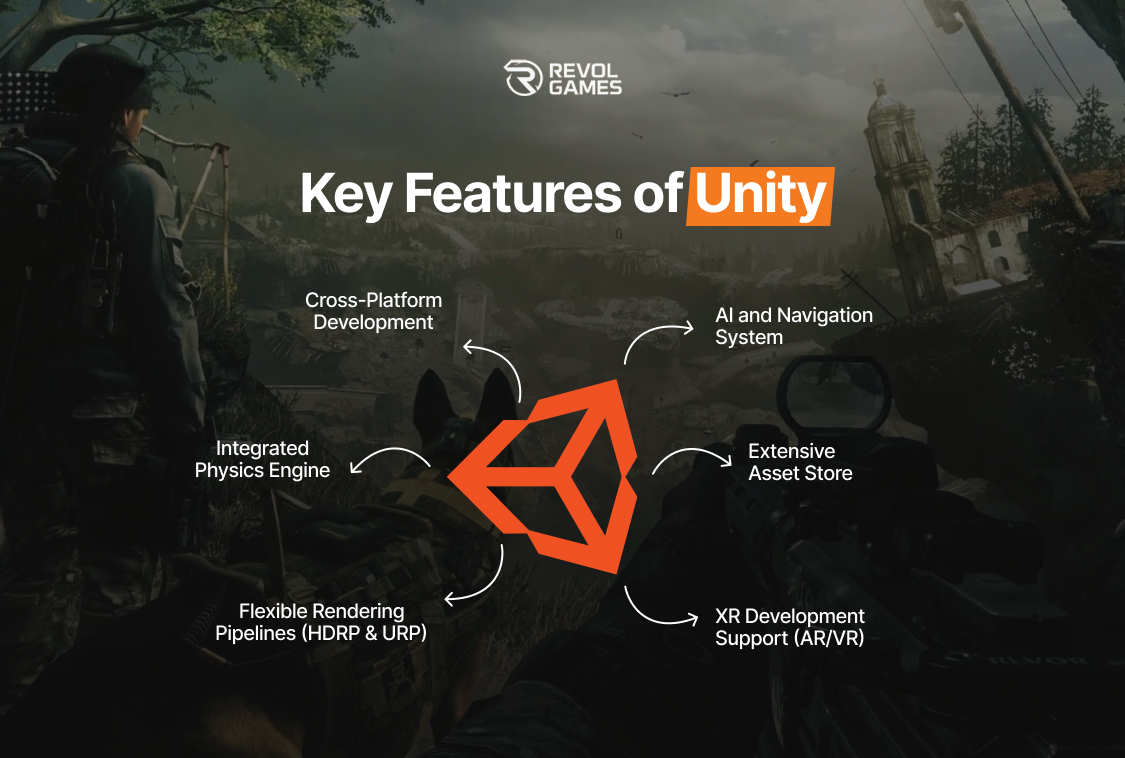
Unity is the most widely used game engine all across the world. Launched in 2005, the engine quickly became the favorite for its versatility and accessibility.
Supporting more than 20 platforms, it is a go-to engine for AR/VR as well as 2d game development. Moreover, the simple interface and its C# scripting make coding easy even for beginners.
Successful Examples
Many major mobile hits like the giant Genshin Impact and indie masterpieces like Cuphead and Hollow Knight show Unity’s versatility.
Strengths
- Unity’s biggest strength is its adaptability. You can build once and deploy across mobile, console, or web.
- The Asset Store provides ready-to-use scripts, models, and shaders that reduce development time.
- Unity has thousands of ready-to-use tool sets for building casual games or 2D titles.
- Its scripting language – “C#” is far easier to learn for beginners.
Weaknesses
- Unity often struggles to match Unreal’s raw graphical power for photorealism.
- Creating 3D projects in Unity still requires extra optimization and third-party tools.
Unreal Engine Overview
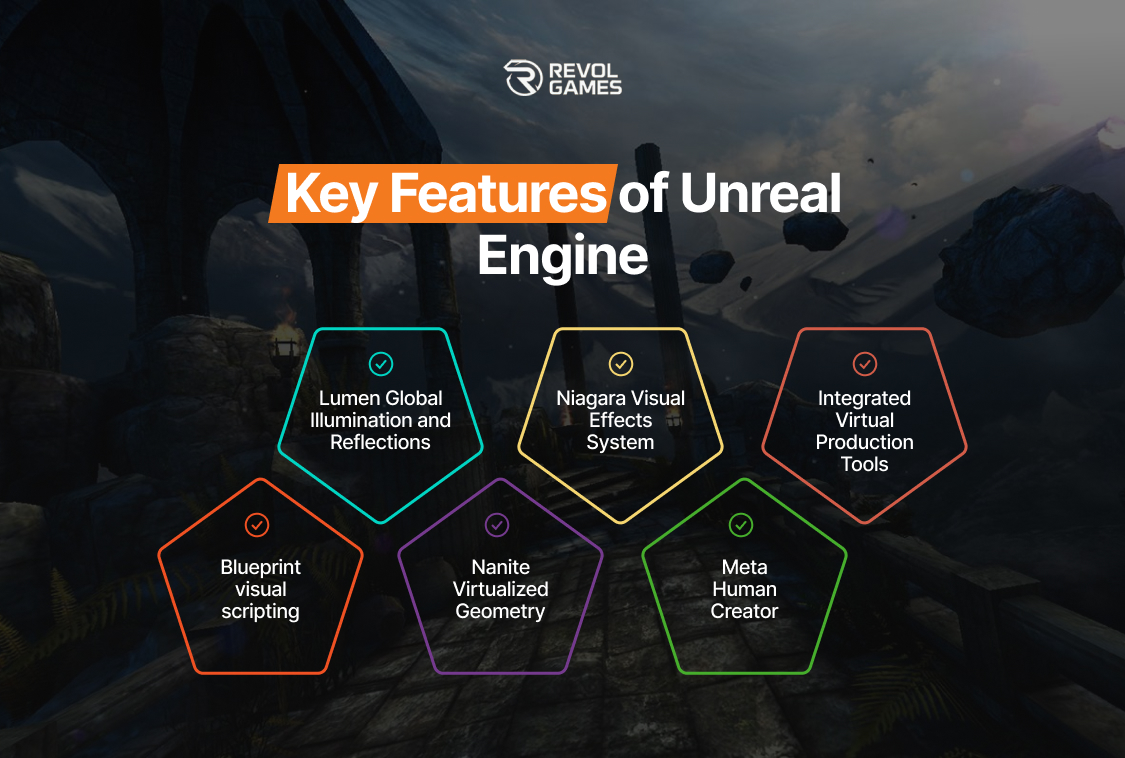
Unreal Engine, developed by Epic Games, has long been the choice for high-end blockbuster 3d video games. This high-performance engine is best for projects where visual fidelity and massive scale are the top priorities.
The current version, Unreal Engine 5.5, pushes the boundaries of real-time graphics further than any other platform.
Well-Know Games
Epic Games built scaling AAA studio-quality projects using Unreal Engine. Famous examples include Fortnite, Gears of War, Final Fantasy VII Remake, and many of the most highly anticipated upcoming titles.
Strengths
- Unreal Engine’s biggest strength is its exceptional visual fidelity. Features like Nanite and Lumen create graphics that look almost photorealistic.
- The engine uses C++ for its core programming, which provides superior performance and low-level control over memory.
- Developers also get full source code access for deep engine customization for 3D game development.
- Its Blueprint Visual Scripting system allows complex logic implementation without writing a single line of code.
Weaknesses
- The weaknesses of Unreal Engine center on its complexity and resource demands. It has a steeper learning curve than Unity.
- The engine itself is physically large and requires high-end PC hardware to run the advanced lighting and geometry features.
Unreal Engine vs Unity For Game Development: Comparative Analysis
The main differences between the two engines come down to underlying architecture. Therefore, we compare them directly across key categories – graphics, language, and community support.
| Feature | Unity Engine | Unreal Engine |
| Programming Language | C# scripting, beginner-friendly | C++ and Blueprint visual scripting, advanced control |
| Graphics Quality | Scalable with URP and HDRP, improving fast | Photoreal rendering with Nanite and Lumen |
| Performance | Optimized for lightweight and mobile builds | Optimized for large open worlds and realism |
| Ease of Learning | Easier for beginners and small teams | Steeper learning curve, better for technical users |
| File Size and Build Time | Small and fast | Larger builds, slower compile times |
| Platform Support | 20+ platforms, including mobile, console, VR | Wide support, but best for desktop and console |
| Community and Documentation | Huge global user base and tutorials | Strong professional community with technical depth |
| Learning Resources | Massive free content, Unity Learn | Official courses, Unreal Online Learning |
| Hardware Requirements | Moderate, runs on mid-tier PCs | High-end GPU recommended for smooth use |
Below, we answer your core question of “Unity vs Unreal Engine, which is better” by looking at these specifics in detail.
Graphics and Visual Fidelity
Unreal is the undisputed champion of out-of-the-box photorealism. Features like Nanite and Lumen ensure that high-end 3D games look cinematic with minimal effort. When talking about games with a high level of VFX, the Unreal Engine vs Unity battle is easily won by Unreal.
Unity approaches graphics with the DOTS framework to improve runtime performance and scalability. It offers two rendering pipelines. URP for mobile and lightweight projects, and HDRP for high-end visuals.
In the Unreal Engine 5 vs Unity debate for graphics, Unreal still wins on default visual polish.
Programming Language & Ease of Learning
This is one of the most critical decisions in the Unreal Engine vs Unity debate because the language choice has immediate effects on your game development process.
Unity uses C# – an object-oriented language that is easy to read. Developers often call it a friendly language for beginners.
Unreal Engine uses C++, which gives developers control over memory and engine operations. The Blueprint Visual Scripting allows artists to design complex game mechanics without writing a single line of code.
While highly effective, the learning of Unreal C++ architecture requires manual memory management. This duality is why Unreal Engine vs Unity for beginners is a hot topic. A pure programmer finds C# easier, but a visual designer finds Blueprints easier.
Performance
Unity vs Unreal performance shows a clear trade-off between accessibility and raw power.
Unity is optimized for lightweight and mobile builds. Its DOTS framework uses multi-threaded systems that keep frame rates steady, even on lower-end devices. The engine manages memory efficiently and compiles fast, so testing and iteration feel smooth.
Unreal Engine focuses on realism. Its World Partition and Nanite systems handle complex game mechanics without manual optimization. Scenes stream seamlessly, and lighting reacts dynamically through Lumen, creating film-level visuals without pre-baked data. While Unreal can handle small games, it shines when scale and realism matter most.
Hardware Requirements
Unreal Engine has higher hardware requirements for development. Its advanced features, like Lumen and Nanite, demand a strong GPU to run the editor and see real-time lighting changes. Teams struggle with development speed when their hardware is substandard.
Unity is more forgiving on older or less powerful machines. It scales gracefully on mid-range laptops. While the high-end HDRP demands a good GPU, its default URP is highly efficient. For educational environments or small remote teams, Unity game development is much easier to manage.
Community Documentation and Support
A strong community is vital for solving those late-night coding problems. Both engines have massive and active communities. However, their nature is slightly different.
Unity has a larger community overall, especially among indie developers and beginners who provide tutorials for nearly every problem imaginable. The sheer number of Unity game development users means you can quickly find help on forums and social platforms.
The Unreal Engine community is also strong, but often more focused on technical challenges and AAA production workflows. Epic Games provides direct support through excellent documentation. This includes the massive Quixel Megascans library of free high-fidelity assets.
The common consensus on the Unreal Engine vs Unity for game development on Reddit is often that Unity is easier to start with, but Unreal is worth the technical struggle if you target AAA.
Unreal Engine vs Unity: Pricing and Licensing
Unity vs Unreal pricing follows two very different philosophies: seat-based subscription vs royalty-based model. Understanding their cost difference is crucial for long-term project planning.
Add “Pricing” Image
Unity’s New Fee System 2025
Unity now uses a clear subscription model. They completely removed the confusing and highly criticized Runtime Fee. The change gives game development teams peace of mind and cost predictability.
- The Unity Personal tier remains free. The revenue and funding limit for this free tier has doubled to $200,000 annually.
- For professionals and larger studios, the Unity Pro costs $2,200 per seat annually.
- Unity Enterprise is required for companies with over $25 million in annual revenue, which is a significant advantage for business budgeting.
Unreal’s Royalty Model Explained
Unreal Engine is free to download and use for development. The key financial metric for Unreal Engine vs Unity is the royalty threshold.
Epic Games does not charge any fees until your game hits $1 million in gross lifetime revenue per title. Once your game crosses that $1 million mark, a 5% royalty applies on subsequent revenue. This model is ideal for small projects that might never reach the payment threshold.
Furthermore, if you sell your game on the Epic Games Store, the royalty fee often drops to 35% which is a nice perk.
Avoid Unexpected Fees with a Clear Budget
Connect with the RevolGames team for financial clarity on Unreal Engine vs Unity.
Unreal Engine vs Unity: Use Cases & Target Audience
The final answer to Unreal Engine vs Unity is often guided by the type of experience you want to deliver to your audience. Each engine dominates specific markets.
Mobile Games
Unity has long been the dominant choice for mobile games. Its efficient Universal Render Pipeline creates small build sizes and runs well on low-end devices. This optimization is crucial for high-quality mobile game design that prioritizes reach and fast loading times.
Unreal Engine is also used for mobile games, but primarily for graphically intense AAA titles to bring a “console experience” to handheld devices. While Unreal can produce superior visuals, it often results in larger sizes and greater hardware demands, limiting its audience.
When you compare Unreal Engine vs Unity for mobile games, Unity wins on accessibility and reach, while Unreal delivers unmatched visuals.
Non-Gaming Industries
Unreal Engine is a leader in non-gaming fields. Its visual fidelity makes it the standard for Virtual Production.
Studios use it to create backgrounds for films like The Mandalorian. It is also heavily used in ArchViz for realistic architectural renderings. Even NASA uses Unreal Engine for high-fidelity simulations and training.
Unity is strong in industrial use cases. Companies use it for manufacturing simulations and automotive training. Its flexibility makes it a favorite for AR/VR applications in healthcare and industrial design.
Both engines have strong non-gaming applications, but Unreal leads in cinematic quality.
Unity 6 vs Unreal Engine 5.x [Upcoming Features]
The Unreal Engine vs Unity engine war never stops. Both companies constantly release new tools and improvements. Knowing where the engines are headed helps you make a future-proof choice.
Unity 6 is pushing the maturity of DOTS, making it easier to build huge, high-performance worlds. Their new rendering workflows also simplify setting up complex lighting and shaders.
It is also doubling down on multiplayer game development services. Focusing heavily on cloud-based services and AI tools, Unity aims to make online functionality a core part of the engine and reduce reliance on third-party solutions.
Unreal Engine focuses on simplifying high-end production. UE5.5 updates are making Nanite and Lumen even faster and easier to use.
They are also improving the Metahuman toolset for creating hyper-realistic digital doubles. This shows a continued commitment to virtual production and high-fidelity art. The next generation of Unreal game development will be even more visually stunning.
Unreal Engine vs Unity: Reddit Recommendation
Aggregating insights from Unreal Engine vs Unity for game development Reddit communities provides real-world context. We found a few common sentiments.
Many developers on Reddit summarize the choice simply by saying:
“Use Unity to make a mobile game or 2D title use Unity. If you want to make the next Cyberpunk use Unreal.”
The consensus is that Unity is better for beginners. Its C# learning curve is generally considered faster and less frustrating than C++ in Unreal.
Conclusion
There is no single winner in the great Unreal Engine vs Unity debate. With Unity, you get versatility and superior support for 2D and mobile platforms. Whereas Unreal Engine offers you unmatched visual fidelity and tools specifically designed for large AAA console titles.
Still unsure, we encourage you to partner with an experienced game development company. At RevolGames, we skillfully use Unity to create engaging mobile success. If you are targeting the highest-end PC and console graphics, our experience in Unreal is top-notch. So, contact us to see which one feels right for your next game.
End the Unreal Engine vs Unity Confusion with RevolGames
Our expert guide helps you build revolutionary games confidently.
Frequently Asked Questions
The better platform between Unreal Engine vs Unity completely depends on your project goals, as they both excel at different things. Small teams choose Unity for mobile games and 2D projects. Go with Unreal for AAA quality photorealism and large-scale 3D console or PC titles.
Yes! Unity can make AAA games. However, it typically requires significantly more custom engineering time and resources. Unity developers often need to build their own tools to manage the scale and complexity that Unreal provides natively. Games like Rust prove that Unity handles huge commercial success.
You should use Unity as a beginner. Its C# is widely accepted as easier to learn than Unreal’s C++. Plus, Unity offers a vast number of free tutorials and a massive community ready to help.
Yes Unreal Engine is free to download and use for all development purposes. You only start paying royalties after your game earns $1 million in gross lifetime revenue. This model is ideal for small studios and hobbyists.
Yes, NASA uses Unreal Engine for mission planning simulations and training astronauts in realistic virtual environments. This highlights the engine’s power for high-fidelity technical visualization beyond gaming.
Related Posts
How to Create a FPS Game Like Call of Duty?
- Posted by admin on October 27, 2025
- Category : Uncategorized
Learn how to develop a thrilling FPS game like Call of Duty with expert tips on design, mechanics, and features…
Unreal Engine vs Unity [Which is Better for Game Development in 2025]
- Posted by admin on October 27, 2025
- Category : Uncategorized
The comprehensive Unreal Engine vs Unity showdown. Compare their visual quality and pricing to find which engine is best for…