

Hyper casual games seem the simplest and easiest to play video games until you look into the budgets that go into their successful execution. Multiple sources quote that hyper-casual game development costs fall between $15,000 to $50,000 for a basic MVP.
It is the basic video game budget breakdown you need. Many people assume that development costs nothing. The truth is that getting a mobile game to millions of users demands a smart investment.
Therefore, we detail every expense involved in the hyper-casual game development cost for 2025. This guide covers the initial development art and the critical marketing test spend.
By the end, you will get a realistic financial plan for your next hit. Because understanding the scope of casual game development is your first step toward launching a profitable game.
Contribution of Hyper-Casual Games in the Gaming Industry Revenue [Latest Insights]
Hyper casual games still lead in mobile downloads and ad revenue charts. The online casual games market is projected to cross $20.57 billion by 2025 (Mordor Intelligence).
Last year, mobile gaming earned approximately $92.6 billion in annual revenue, as per TekRevol. And hyper-casual games revenue has made a major contribution to that. In 2024, top hyper casual titles achieved over 100 million installs in a few months.
Once considered a fad, hyper-casual games have become a fundamental shift in mobile gaming consumption. The segment performs well worldwide because of its instant gratification feature. Ad networks report eCPMs (effective cost per mille) in key markets like the US, reaching $8–$15 on rewarded video.
In fact, a report from Gamesforum noted the top 100 hyper-casual games made $345 million from in-app purchases in the first half of 2025. This shows the casual game development shift toward deeper monetization.
Enjoy a Lucrative Revenue with RevolGames
Optimize your hyper-casual game development cost with our expert strategies to achieve the highest return on your investment.
Quick Estimate of Hyper-Casual Game Development Cost For 2025
A basic hyper casual game development costs between $15,000 – $40,000 in the United States. However, for a high-retention title, the spend is between $50,000 and $100,000 due to complexity.
Tiered Cost Table: MVP versus Mid-Core versus Premium
Below, we break down the estimated amount for 3 distinct project tiers. This quick view gives you the necessary context around “what is the cost of developing a hyper-casual game” right away.
| Tier | Cost Range (USD) | Development Time |
| MVP (Prototype) | $15,000 – $40,000 | 4 – 8 Weeks |
| Mid-Core (Standard) | $40,000 – $75,000 | 8 – 12 Weeks |
| Premium (High-End) | $75,000 – $100,000 | 12 – 20 Weeks |
Even at the high end, the total hyper-casual game development cost remains significantly lower than standard mobile games. That’s because of simple gameplay and a minimalist art style. Consequently, the bulk of your expense shifts from complex coding to rapid, aggressive marketing and prototype testing.
7 Factors That Define the Hyper-Casual Game Development Cost
The base price for your project is heavily influenced by 7 core decisions. Each choice directly affects the total video game budget breakdown. Understanding these factors helps you control your investment in hyper-casual game development costs.
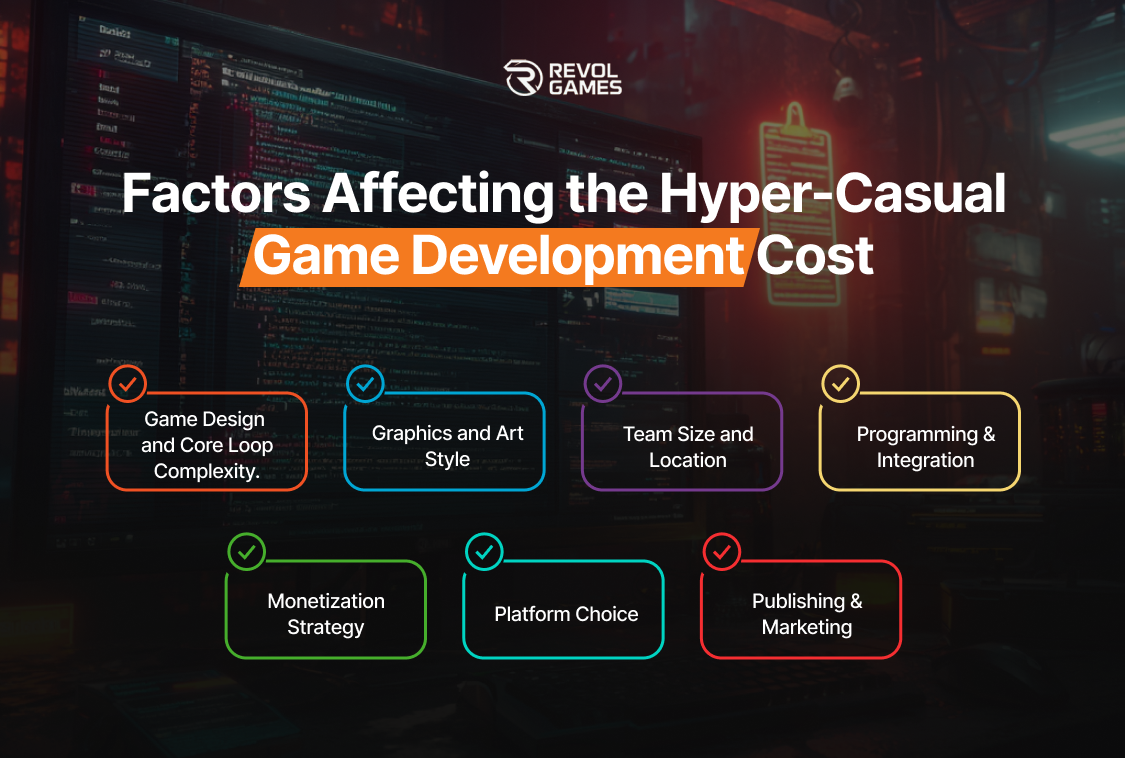
1. Game Design and Core Loop Complexity
Complexity is the biggest driver of cost.
A simple casual games loop involves one single action that a user repeats, such as tapping or swiping. This simplicity requires less code and fewer assets. For example, a “stacking blocks” game is cheaper than a “merge and collect” game because the latter needs more systems.
Recommended: Keep your core game mechanics minimal to lower your initial hyper-casual game development cost.
2. Graphics and Art Style
The hyper-casual look is defined by simplicity. Most games are developed using flat colors and basic shapes. That simplicity minimizes the time an artist spends on production.
Contrary to that, when you opt for high-fidelity graphics or 3D modeling, your cost will jump immediately. Reason? 3D game development requires more specialized talent and time for optimization.
Recommended: Stick to a simple and easy-to-read style for the best balance of hyper-casual game development cost and performance.
3. Programming and Integration
The amount of third-party integration directly adds to development time and so to the final price.
All hyper-casual games need integration with multiple ad networks and analytics tools. This factor is non-negotiable for monetization. However, adding features like leaderboards or social sharing systems increases code complexity.
Recommended: Make a clean and efficient code base to avoid problems later when you start the soft launch.
4. Team Size and Location
Where and how you hire talent matters most for hourly rates.
Hiring a large in-house team in the USA is the most expensive route. Contrary to that, outsourcing your project to a dedicated Android or iOS game development company overseas can cut labor costs by 50% to 70%.
Recommended: Keep the team small and focused during the initial development phases.
5. Monetization Strategy (Ad SDKs, IAPs)
The cost is affected by how deeply you integrate the advertising systems.
Implementation of standard rewarded video ads seems relatively simple and light on the pocket. However, you need extra time and cost to set up complex ad mediation platforms that switch between networks to maximize revenue.
Recommended: Be careful to include even basic in-app purchases, as handling transaction processing and security will eventually increase the total cost
6. Device Support (Native vs Cross-Platform Engine)
Your choice of engine, whether Unreal or Unity game development, affects the programming time. A cross-platform approach becomes the most popular for mobile game development. The team uses a single codebase that runs effectively on both Android and iOS devices, reducing the overall hyper-casual game development cost.
Recommended: Go for a hybrid, as building native games for Android and iOS separately is much more expensive and usually unnecessary for this genre.
7. Publishing and Marketing
Development is only half the budget story. The final cost includes the time spent preparing the store assets, app description, and submitting the game.
Crucially, it also includes the initial testing marketing budget. You must spend money to find your CPI sweet spot before a publisher will invest.
Recommended: Do not slack here, as the initial test is a vital part of the overall video game budget breakdown.
Average Cost to Develop a Hyper-Casual Game in 2025 (Detailed Benchmarks for USA)
The cost of making a mobile game in the USA in this genre typically falls between $20,000 and $100,000 for the pre-publishing version. Your final hyper-casual game development cost depends on whether you seek a basic prototype or a fully polished game ready for mass scaling.
Here is a simple mobile game cost estimate that top game development studios in the USA use when quoting projects.
| Game Type | Cost Range (USD) | Time (Months) | Team Size | What You Get |
| MVP Build | $20,000 – $40,000 | 1–2 | 2–3 people | Basic 2D loop, minimal art, and ad integration. |
| Standard Release | $45,000 – $80,000 | 3–4 | 4–5 people | Polished visuals, analytics, and multiple ad formats. |
| High-End / Hybrid Casual | $100,000 – $150,000 or above | 5–6 | 6–8 people | 3D graphics, live ops, backend, retention tracking |
MVP Build
A minimum viable product (MVP) focuses on the core loop. At this level, you can skip advanced visuals and test to validate the idea first. Many teams build a few versions and test their CPI to scale what performs better. This model fits early-stage creators who want proof of concept at a lower game development budget range.
Standard Release
A mid-tier build adds strong UI, analytics, and stability for both iOS and Android game development. You also start integrating multiple ad networks or rewarded video to check return on ad spend. This level usually suits small publishers and funded indie teams.
High-End or Hybrid Casual
Large game development studios in the USA invest in live operations, 3D visuals, and personalized gameplay. These features extend retention and increase hyper-casual games revenue. But at the same time, they push the budget to the top range. Most projects in this bracket also require deeper testing and long-term updates.
Hyper-Casual Game Development Cost Breakdown Across Strategic Phases
Every successful hyper-casual title follows a structured process. This phased approach allows you to control your hyper-casual game development budget and pull the plug early if the metrics fail. Preparing a breakdown is the smart way to handle the stages of game development.
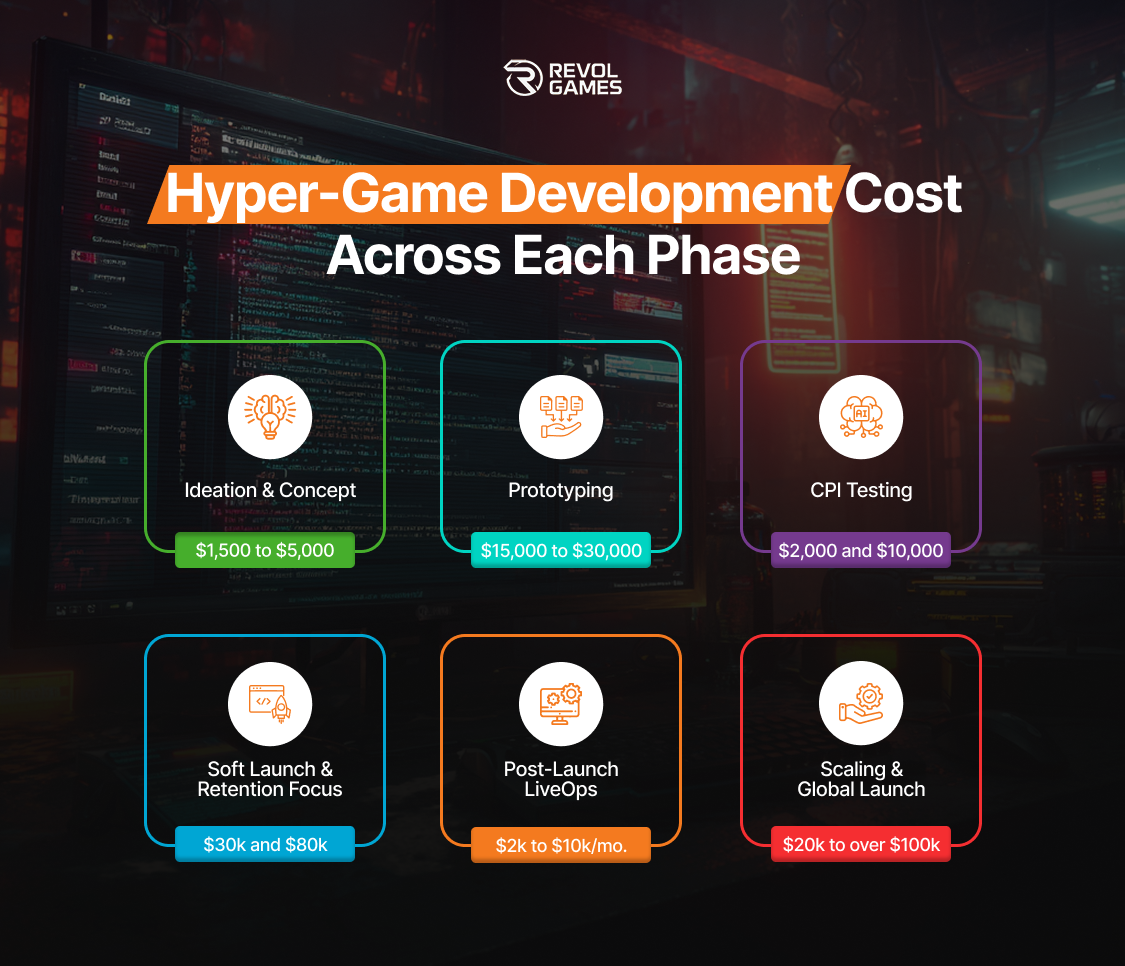
1st Stage: Ideation & Concept (Minimal Cost):
This phase involves generating ideas and drafting the Game Design Document (GDD). The cost is primarily internal labor for the Game Designer. The spend involved is generally $1,500 to $5,000 for consultation and documentation.
2nd Stage: Prototyping (Core Development Cost)
This is the rapid creation of a playable prototype to test the core loop fun factor. It uses placeholder art and minimal code. This phase absorbs the first major hyper-casual game development cost, typically ranging from $15,000 to $30,000.
3rd Stage: CPI Testing (Limited Product Release Cost)
You create short and engaging video ads to run small ad campaigns to calculate the Cost Per Install (CPI). This is a purely marketing-focused spend. The necessary cost spent here is usually between $2,000 and $10,000 for targeted ad spend.
4th Stage: Soft Launch & Retention Focus (Highest Development Cost)
If the CPI is low and promising, the team polishes the game design. The launch phase requires finalization of art and sound. It also includes completing all necessary SDK integration. This work carries the main bulk of the casual puzzle game development effort. So, you should expect this phase to cost between $30,000 and $80,000 or even more.
5th Stage: Scaling & Global Launch (Marketing Cost)
The game is released globally, shifting focus to large-scale user acquisition. The cost here is entirely marketing-based and is often continuous. The initial launch budget can range from $20,000 to over $100,000, depending on the publisher’s strategy.
6th Stage: Post-Launch LiveOps (Operational Cost)
The team provides maintenance, bug fixes, and continuous content updates. This effort is necessary to maintain player engagement and maximize LTV. This operational cost is typically $2,000 to $10,000 per month.
Worried About Unnecessary Spending?
At RevolGames, we strategize your hyper-casual game development costs to ensure maximum efficiency and higher profitability.
Monetization Models of Hyper-Casual Games for Profitability
Profitability in this sector is not about high individual sales, but millions of tiny ad revenues. The financial model to dilute the hyper-casual game development cost with profit is simple. If the revenue generated by a player is higher than the cost to acquire them, the game is profitable.
Here are three primary monetization models used in the market today.
1. In-App Advertising (IAA)
IAA is the foundation of the hyper-casual market and remains the largest income stream. You will see three common formats:
- Rewarded video ads that give players a bonus or extra life.
- Interstitial ads between levels.
- Banner ads for constant exposure.
Rewarded videos often deliver the best performance because users choose to watch them. In 2025, average eCPM rates in the United States range from 8 to 15 dollars for rewarded ads and 3 to 6 dollars for interstitials.
A well-optimized ad setup can bring high hyper casual games revenue even with free players. Let’s say your game gets one million installs and earns an average eCPM of $10. That could generate around $70,000 in ad income over its lifetime.
2. In-App Purchases (IAP)
While considering the best for mid-core games, in-app purchase use is growing in hybrid casual titles. They monetize the most engaged players by enticing them to purchase non-consumable items like extra lives or special skins.
While not the main hyper casual games revenue stream, IAPs serve as an important key to maximizing the revenue of the casual game development model.
3. Hybrid Model
Some studios now use a hybrid model that blends ads with light in-app purchases to secure long-term hyper-casual games revenue. Players can buy cosmetic skins or power-ups. They also offer a premium tier without any ad breaks, which is the most common IAP.
These features work best when you design a mobile game around replayable loops. Hybrid models also extend playtime, which improves lifetime value and offsets marketing costs.
How Do You Calculate Your Hyper-Casual Game Development Cost Budget?
The most practical way to estimate your hyper-casual game development cost is to calculate the number of individuals required and the hours they work. This simple method applies whether you hire a small freelance team or a full mobile game development company.
Here’s the fundamental cost formula: Cost (Total Man-Hours×Hourly Rate)
It acts as your own personal hyper-casual game development cost calculator. However, you must break the project down by the core roles involved in the casual game development process:
- Game Designer (GDD creation, balancing, loop refinement)
- Developer (Programming, SDK integration, optimization)
- 2D/3D Artist (Creating assets, UI design, animation)
- QA Tester (Device testing, bug finding, quality assurance)
For example, a high-quality standard game might require 1,000 total production hours. If you hire a quality offshore team at $50 per hour, the pure labor cost is $50,000. But to hire a US team, expect the rate of $120 per hour, so your labor cost becomes $120,000.
This stark difference highlights the importance of managing your game development budget range by team location. Always add a 15-20% buffer for unseen issues and project management overhead.
Future Trends That Will Affect Hyper-Casual Game Development Cost
The gaming market is moving past basic hyper-casual titles and is fully embracing the hybrid casual game development trend. These changes affect the hyper-casual game development cost by increasing the complexity of the finished product.
To stay competitive, keenly adopt the following five trends that currently dominate the market in the USA and abroad:
- Deeper Meta Layers: Progression systems and base-building game mechanics drive player retention. This necessary integration demands more design and programming hours, which directly increases your hyper-casual game development cost.
- AI-Powered Personalization: AI now handles personalization. Algorithms adjust game difficulty and optimize ad delivery automatically. Integrating this advanced tech stack adds significant complexity and development time.
- Advanced AR/VR Implementation: Simple Augmented Reality (AR) features offer unique, real-world gameplay moments. Implementing AR requires specialized developer expertise and extensive testing. This adds complexity and raises the project budget.
- Focus on Social Features: Social features like leaderboards or simple guild mechanics build a vital community. These additions require backend servers and networking code. Expect this to raise the initial hyper-casual game development cost significantly.
- Cross-Platform Virality Design: Design your game for virality from day one. You must create clip-worthy moments optimized for social platforms like TikTok. This strategy demands specific design choices and extra marketing assets upfront.
Conclusion
We have detailed every component of the hyper-casual game development cost. A successful hyper-casual launch is about smart spending, not maximum spending. The development cost for a market-ready game sits between $40,000 and $75,000.
If you have your idea ready, start building a detailed video game budget breakdown based on our guide. However, for professional guidance and precise cost estimates, the best course of action is to partner with an expert mobile game development company like RevolGames to turn your concept into a viral reality.
Let's End the Uncertainty About Your Game Idea
Discuss your project with our experts to get a transparent and accurate hyper-casual game development cost estimate.
Frequently Asked Questions
While hyper-casual is the king of downloads, the puzzle and casino genres often generate higher revenue per user. However, their development cost and marketing budgets are also significantly higher than hyper-casual titles.
Yes, hyper casual games are profitable if they pass the key performance indicator or KPI tests. A game must demonstrate a high Day 1 retention rate (D1R) of over 40% and a low Cost Per Install or CPI. Profitability comes from aggressive scaling, not from the initial hyper-casual game development cost.
A game requires a budget of at least $50 million to $150 million to be considered AAA. These games involve hundreds of staff, years of development, and cutting-edge technology. That’s why their cost clearly contrasts with the small budgets needed for hyper-casual titles.
Games like Dota 2 and League of Legends are among the most profitable eSports games globally. Their profitability comes not from the competitive scene itself but from selling in-game cosmetics and battle passes to their massive global player bases. Their business model is entirely different from the ad-based hyper-casual sector.
Related Posts
How Much Does Unity Game Development Cost
- Posted by admin on March 25, 2026
- Category : Game Development
The best part about making a Unity game is that, for indie developers, small and large gaming companies, they need…
iOS vs Android Game Development Which Should You Build First?
- Posted by admin on March 6, 2026
- Category : Game Development
So, you’ve got a brilliant game idea, but now comes the question that stops most developers in their tracks: do…
How Much Does NFT Game Development Cost? A Practical Guide
- Posted by admin on February 9, 2026
- Category : Game Development
You have an NFT game concept that proves to be the next Axie Infinity or Gods Unchained? That’s exciting! But…