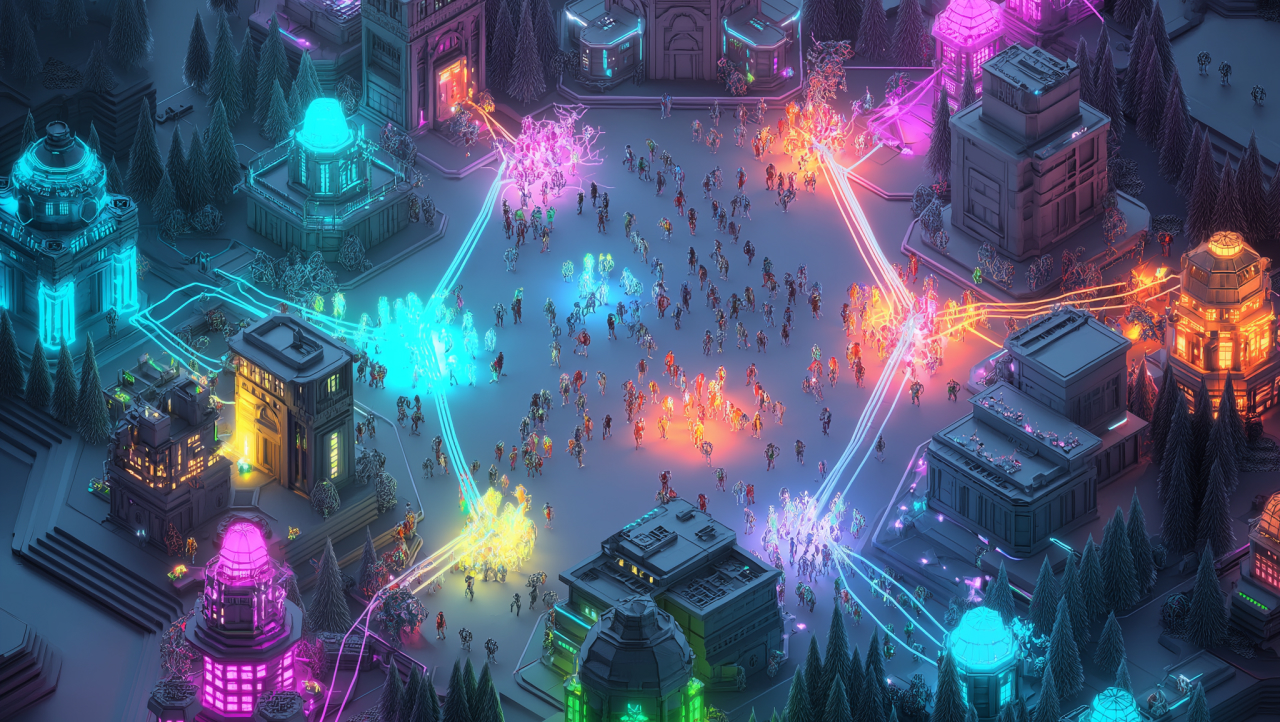
Every great battle needs a great plan, and when it comes to Real-Time Strategy Games, that plan has to be created within the moment. Right before the enemy takes his first step. One minute, your army is working to gather resources, and the next minute, the opponent is destroying whatever you have built so far. It’s all chaos and calculation together in a perfect sync. This is what makes RTS games so addictive.
However, those armies, minimaps, and the thick air of making choices in a split second that players experience on their screens are only the surface. There is a brilliant game development strategy that holds a complex network of logic, systems, and design choices altogether.
Many might think that creating a real-time strategy is all about sketching out battlefields and coding combat mechanics, but it is more than that. An RTS game is about building a world that responds to the commands of every player in real-time. This is the genre where every millisecond counts, and every decision of a developer decides the win or loss.
Let’s read the next sections to uncover what defines a true RTS, the core pillars of strategy game development, and see how creating these games is about building a world that keeps thinking all the time.
What Is a Real-Time Strategy (RTS) Game?
A Real-Time Strategy Game is a genre of video games where players control everything at the same time without taking breaks or pauses. The whole battleground works at the same time, which requires players to think and act in a split second.
Unlike many turn-based strategy games, where players get enough time to plan their strategies, RTS games require quick decision-making tactics. The battlefield stays active and keeps moving whether you are ready or not. This creates a constant state of tension and urgency, which also makes this genre boost with energy and excitement.
And when we look from a developer’s perspective, creating an RTS demands a strong game development strategy. Every system must run in perfect sync. This is the real essence of real-time strategy game development, where every second counts.
Ready to Transform Your Game Development Strategy into a Real-Time, Reactive Battleground?
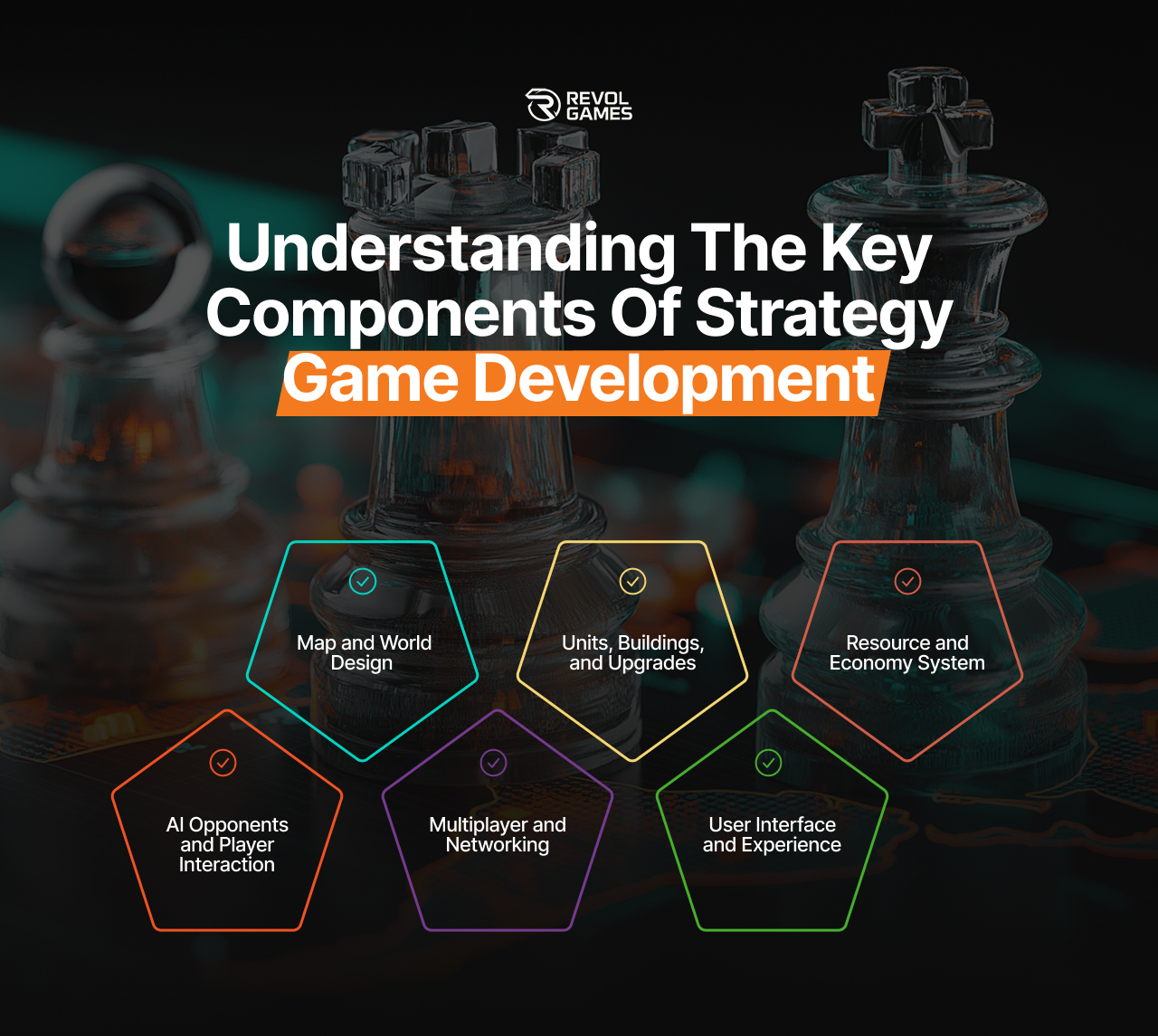
Understanding the Key Components of Strategy Game Development
A hit Real-Time Strategy game is built on strong foundations. Different systems hold the entire gameplay together. It includes maps, economy, AI, and the balance. Each part is connected to the other, which shapes how players decide their next move.
-
Map and World Design
Every RTS game is built on strategy, and the game map helps to define it. Every hill or forest changes the way players move through the game, fight the opponent, and plan their next step. A strategically designed map allows players to think more, “Do I defend this choke point or start to make my way towards a resource field?”
Designing a perfect world means balancing symmetry and unpredictability. Every area of that world serves a purpose. It challenges players to adapt and rewards them for exploring different corners.
-
Units, Buildings, and Upgrades
In real-time strategy game development, units and buildings act as a tool for storytelling and control. Each one exists with a purpose. A well-defined unit system allows players to think strategically.
Upgrades also add a layer for rewarding players for surviving long enough to improve their tactics.
-
Resource and Economy Systems
Resources decide the growth rate of players, how long they can fight, and when they must take risks. To make a good economy, make sure that there are enough resources to keep the excitement alive.
Little resources create a sense of panic among players, while a lot of resources can remove the challenge.
So the real trick is to make every resource matter. Each one must come with a choice of using it now or saving it for later.
-
AI Opponents and Player Interaction
AI opponents define how interactive an RTS game is. It shapes how players face challenges and tension. A well-designed AI thinks ahead of time, also makes mistakes like normal players, adapts to the strategies, and pushes the player to stay alert.
Game creators usually build this intelligence by using behavior trees or state machines in their game development strategy. This helps AI opponents to adjust accordingly as per the players’ actions and situation, without disrupting the game flow.
-
Multiplayer and Networking Considerations
If you have already played an RTS with lag, then you are already aware of why networking matters. Even a one-second delay feels like forever. Your command goes out, but as soon as the screen freezes, all of your army is gone. This is the exact reason why multiplayer has to be considered since the beginning of the game development strategy.
And let’s not forget about networking. In real-time strategy game development, it means that you have to continuously deal with exchanging data. Informing your teammates about unit positions, actions, and resources means that you are aligning your decisions with each other in real time.
So, for a smooth multiplayer experience, creating systems for tolerating latency, predictions, and rollbacks at the very beginning can save you months of fixes.
-
UI/UX
In real time strategy game development, the UI serves as the communication between the players. It is more than just a presentation. Since RTS games are a bit complex, which include multiple systems running at the same time, a clean user interface helps players to stay in control and make informed decisions quickly.
This clarity begins in a well-defined game design document, in which UI/UX are prioritized with mechanics and balance. It may sound like planning where to place buttons and create minimaps, but it includes creating a logical flow that supports how players act in moments of pressure.
-
Balancing and Game Loop Design
Balance holds everything together in a real time strategy game development. It makes the gameplay fair, challenging, and keeps players coming back to play another battle. Every unit and upgrade needs to give a powerful experience to the players without crashing the game. Maintaining this balance can be considered as one of the critical parts of the game development strategy.
The best game development studio usually adapts that balance by adjusting values, testing matchups, and collecting feedback from the players. These loops of feedback and tweaks make a game feel exciting and fair to play.
The game loop design is created on this balance. It sets the pace of how players get resources, how battles escalate, and when tension increases. A strong game loop provides players with a feeling of progress and control to keep them invested from the beginning to the last win.
Strategy Game Development Software: Choosing the Right Tools
A good game development strategy depends on the toolkit you choose. It decides how far your project can go. A real time strategy game development software helps you map out your mechanics, test systems, and build real game worlds. From game development engines to animation software, each and every tool plays a certain part in giving a face to your game design.
A study from 2024 issues that, publishers now hold $136 billion out of $262 billion in the global video game market, which highlights that how competitive this industry has become, holding too many opportunities. However despite dominating the space, it has also become important for studios to use the right tools and technology to stay competitive in this growing industry.
Game Development Engines
Every RTS begins with a right engine. The one that shapes up your gameplay. The right engine defines how your team works on the game development strategy and scales it.
- Unity: Unity is a flexible and easy-to-use game development engine, which makes it an ideal option for indie studios and beginners. It supports both 2D and 3D game development, contains a huge store for assets, and integrates easily with other popular libraries and path-finding tools. Unity is also one of the smartest game engine choices to create cross-platform and mobile games.
- Unreal Engine: Unreal is used to build large-scale and high-performing RTS games. Its visual scripting system and blueprints allow designers to create prototypes of complicated systems without learning deeply about how to code.
- Godot: Godot is an open-source engine used by developers who prefer freedom and simplicity. It is lightweight, free, and used to develop 2D or small 3D RTS games.
Graphics and Animation Tools
Graphics tell the story even before the words in every real time strategy game development. The layout of the battlefield and even the shadows all depend on the right tools
- Blender: When it comes to one of the best 3D modeling and animation tools, Blender stands at the top of the list. It works wonders for creating characters, layouts, and assets.
- Adobe Photoshop: Photoshop remains important for creating textures, concept art, and UI. It is the go-to tool for artists who love to design with precision and flexibility. It also saves a lot of time in exporting optimized game assets directly to game engines.
- Autodesk Maya: This one is used to create cinematic animation. Maya offers professional features for high-quality rigging and animation. For teams that want cinematic animation, Maya offers a professional-grade environment for rigging and animation. It is also used in creating AAA RTS production pipelines for its robust keyframing tools and detailed skeletal control. Ideal for animating real buildings, scenarios, and units.
Audio Tools
Sound also plays a major role in your game development strategy. It helps in building tension and rhythm. The right tools for composing audio align gameplay and emotions smoothly.
- FMOD: It is a standard tool in the industry that allows you to design adaptive and event-based sound systems. It easily connects audio directly to the events in the gameplay, like siren sounds for alerts or gathering resources, without the need to manually code sound triggers. Another good factor about FMOD is that it can be easily integrated with Unity and Unreal.
- Wwise: Wwise offers a more advanced audio pipeline, especially for huge titles. It provides full control over sound layering and reverb. Most RTS game developers use it for creating real sounds for battles, like clashing and explosions.
Pathfinding and Movement Frameworks
Movement and pathfinding frameworks are as important as every other real time strategy game development software. They turn a simple strategy into action.
- A* Algorithm: One of the most commonly used algorithms for pathfinding. It helps in calculating the closest routes to move from point A to point B in less time. A* strikes a proper balance between speed and accuracy, which makes it a top choice for making a real-time decision.
- Unity NavMesh: It is a built-in movement and pathfinding framework in Unity. NavMesh helps in simplifying navigation by generating traversable areas automatically. It is also helpful in creating instant prototypes.
Programming Languages
Programming languages hold the power to decide the performance and workflow of your game. Think of them as a crucial aspect of your game development strategy, especially when it comes to building a Real-Time Strategy game.
- C++: A powerful framework, a perfect choice for building AAA games and custom-built engines. It gives proper control over performance, which makes it perfect for real time strategy game development.
- C#: It is used in Unity game development. It is fast, easy, and made for instant fixes. C# is the right choice for building small to mid-sized RTS games that need continuous cross-platform support.
- Java: Java can be used to develop browser-based or mobile games, and is less common for creating modern 3D RTS games.
Selecting Software Based on Scope
Selecting the right strategy game development software highly depends on the size of your team, project, and goals.
A small team often chooses solutions like Unity or Godot for accessibility and flexibility. These engines provide easy and fast prototyping and iterations without complicating things. On the other hand, big game development studios use the Unreal game development engine, Autodesk Maya, and other advanced software for creating scalable and high-end RTS games.
Another important thing is to maintain balance with available resources. Open-source real time strategy game development software is budget-friendly, but it needs more technical maintenance. Meanwhile, enterprise software offers powerful support and a lot of integration options.
Let's Set the Foundation of Your RTS with the Right Tools.
Best Practices for Real-Time Strategy Game Development
Image 2:
Once your strategy game development software and systems are carefully planned, this is the moment when you have to move forward with actually building it. This is the part where your perfectly mapped game development strategy becomes a real RTS game.
For many new developers, it is easy to get stuck in creating everything altogether; however, a smart game development strategy involves proper pace, careful testing, and making improvements in every step.
-
Start Small and Prototype Quickly
Begin with a simple prototype for your RTS game. Do not get straight into designing huge maps or units. Start with a single mechanic and one playable ma. This MVP helps in understanding how your game is actually going to feel once it goes live.
-
Prioritize Performance Early
Real-Time Strategy games come with loads of demands. You have to deal with numerous units, live resoucers, and updates. Performance issues can increase instantly if you do not prioritize optimizing your game early.
Use Unity tools or Unreal Engine’s built-in performance analytics at the beginning of your game development strategy. Focus on batching draw cells, LOD management, and update loops.
-
Design Clear and Transparent Mechanics
Players do not get enough time to think about what’s happening in real-time battles. They need to see everything right away. This is why it is important to keep the factor of clarity intact.
Keep your systems easy to understand but a little deep to master. Every resource that players have collected or abilities they have used must show the impact they have on the battlefield. The clear design and transparent mechanics help in reducing bugs and confusion during the testing phase.
-
Implement Smart and Scalable AI
Every real time strategy game development requires AI opponents that provide players with the sense of playing with a real player. AI-driven NPCs that respond accurately can increase player retention rate by 40%.
Start by using rule-based AI and slowly add difficulty by using behavior trees. Keep your focus on adaptability when you scale. An AI player that changes its tactics based on choices made by a human player feels more rewarding than one that always makes predictable moves.
-
Build Robust Multiplayer Systems
Multiplayer systems hold the power of turning your RTS game into the next hit. To get it right, you need to keep thinking about networking from the initial phase of your game development strategy.
Plan for latency, tick rates, and player synchronization early. Avoid creating single-player systems. Also, make sure to test under multiple network conditions to create a smoother gameplay.
-
Balance, Playtesting, and Iteration
You need to keep refining the balance in your game development strategy. It is not something that you can expect to get right the first time. Use spreadsheets to track stats, budget, and time. Keep playtesting with other players to identify issues that you might miss sometimes.
-
Prepare for Live Ops and Post-Launch
Your work does not end once you launch your game; it just shifts from one aspect to another. Make sure to plan your live operations early, so you don’t get surprised with sudden updates, patches, and analytics.
Moreover, a study shows that 84% revenue of mobile in-app purchases was generated through games using live-ops, which proves that live-ops is not optional anymore.
A robust post-launch plan helps in keeping your player base active and allows your RTS game to thrive in the gaming industry.
Examples of Successful RTS Games
There are many great examples of successful Real-Time Games that can help you master your game development strategy by analysing what made them great.
Some of these games give a lesson on how to build powerful economies and AI systems, while others tell you the power of storytelling and accessibility. Below, we are going to see the quick tables of successful RTS games across different platforms.
Classic PC-Based Titles
| Game Title | Release Year | What Made It Great | Key Takeaway |
| StarCraft II | 2010 | Proper balance, deep competitive scenes, and distinct factions. | Perfect example of balance-driven RTS design. |
| Warcraft III: Reign of Chaos | 2002 | Introduced hero units and story-driven campaigns. | Showed how narrative and strategy can blend. |
| Age of Empires IV | 2021 | Modern visuals with classic gameplay systems. | Reinvented a timeless formula for new hardware. |
Modern/Indie RTS Titles
| Game Title | Release Year | What Made It Great | Key Takeaway |
| Northgard | 2017 | Blends city-building with survival mechanics. | Innovative balance between micro and macro gameplay. |
| They Are Billions | 2019 | Mixes RTS with zombie survival. | Showed how hybrid genres can refresh the RTS appeal. |
| Tooth and Tail | 2017 | Simplified controls, accessible yet strategic. | Proved RTS can thrive with minimal input design. |
| Iron Harvest | 2020 | Diesel-punk twist on classic strategy warfare. | Strong storytelling through unit and world design. |
Mobile/Console RTS Titles
| Game Title | Release Year | What Made It Great | Key Takeaway |
| Clash of Clans | 2012 | Simplified strategy for touchscreen gameplay. | Set the standard for mobile strategy loops. |
| Iron Marines | 2017 | Real-time battles optimized for mobile UI. | Smart use of pacing and intuitive control design. |
| Command & Conquer: Rivals | 2018 | Real-time skirmishes redesigned for short sessions. | Adapted classic RTS tension to mobile timing. |
| Halo Wars 2 | 2016 | Large-scale RTS designed for controller input. | Great study on adapting RTS for console gameplay. |
How RevolGames Can Help You in Real Time Strategy Game Development?
Creating a Real-Time Strategy game is all about building a world where everything reacts and challenges players in every passing second. Behind every thrilling moment is a perfectly executed game development strategy that balances design, systems, and human psychology.
A hit RTS game involves creating a proper rhythm where tension meets flow and every resource feels meaningful. From creating economies to designing engaging UI, real time strategy game development is an art and science that rewards precision and creativity equally.
And to make the next hit RTS with a game development strategy, our team at RevolGames always welcomes you. We will help you in creating a playable strategy world with end-to-end production support, AI design, multiplayer systems, and post-launch maintenance.
So, if you dream of introducing a strategy game that thinks as fast as your players, RevolGames is ready to make it happen.
Partner With RevolGames to Power Your Game Development Strategy into the Next RTS Masterpiece.
Frequently Asked Questions
RTS means Real-Time Strategy. It is a genre of video games where players have to control armies, build bases, and make quick decisions in the nick of time. As compared to other turn-based strategy games, these require gamers to think and react instantly.
The most popular RTS games of all time include Total Annihilation, StarCraft 2, and Clash of Clans. Each of these RTS games shaped the criteria of RTS via unique mechanics, AI innovation, and world design.
Pathfinding and movement are the processes that allow players to move smartly across the map by finding the fastest and safest routes. Properly optimized pathfinding systems minimize lag, avoid unit collisions, and create a real battlefield behaviour.
Choose Unity or Godot as your go-to real time strategy game development software if you are a beginner. Unity offers friendly tools, a huge store of assets, and C# scripting, which makes it ideal, or small teams and indie RTS projects. On the other hand, Godot is a free and open-source software without demanding heavy systems. Both of these engines support 2D and 3D game development, provide cross-platform games, and add easily with different frameworks.
Related Posts
How Much Does Unity Game Development Cost
- Posted by admin on March 25, 2026
- Category : Game Development
The best part about making a Unity game is that, for indie developers, small and large gaming companies, they need…
iOS vs Android Game Development Which Should You Build First?
- Posted by admin on March 6, 2026
- Category : Game Development
So, you’ve got a brilliant game idea, but now comes the question that stops most developers in their tracks: do…
How Much Does NFT Game Development Cost? A Practical Guide
- Posted by admin on February 9, 2026
- Category : Game Development
You have an NFT game concept that proves to be the next Axie Infinity or Gods Unchained? That’s exciting! But…