Imagine you build a game app lying right in front of you. A game where players tap jump, or think their way through a world you designed. The sheer thrill of not only playing but creating something that others are entertained by is awesome. If you aim at creating the next big viral hit or just want to know the process, learning how to make a game app is a worthwhile skill in the app-driven world of today.
The mobile game market is thriving. This sector is amazingly profitable as there are billions of smartphone users globally. However, the procedure of transforming a concept into a functional and profitable mobile game app requires planning as well as adhering to a detailed strategy.
From the first concept to the point of release, this book will walk you through the precise procedures and techniques for creating an app game from the store in a unique, understandable, and useful way.
Finally, you will have a plan to create your own game, comprehend different types of mobile games, and understand how a partner like RevolGames can facilitate the realization of your dream. So let’s get started and find out how to create a mobile game app from the ground up.
How to Make A Game App: Step-by-Step Guide
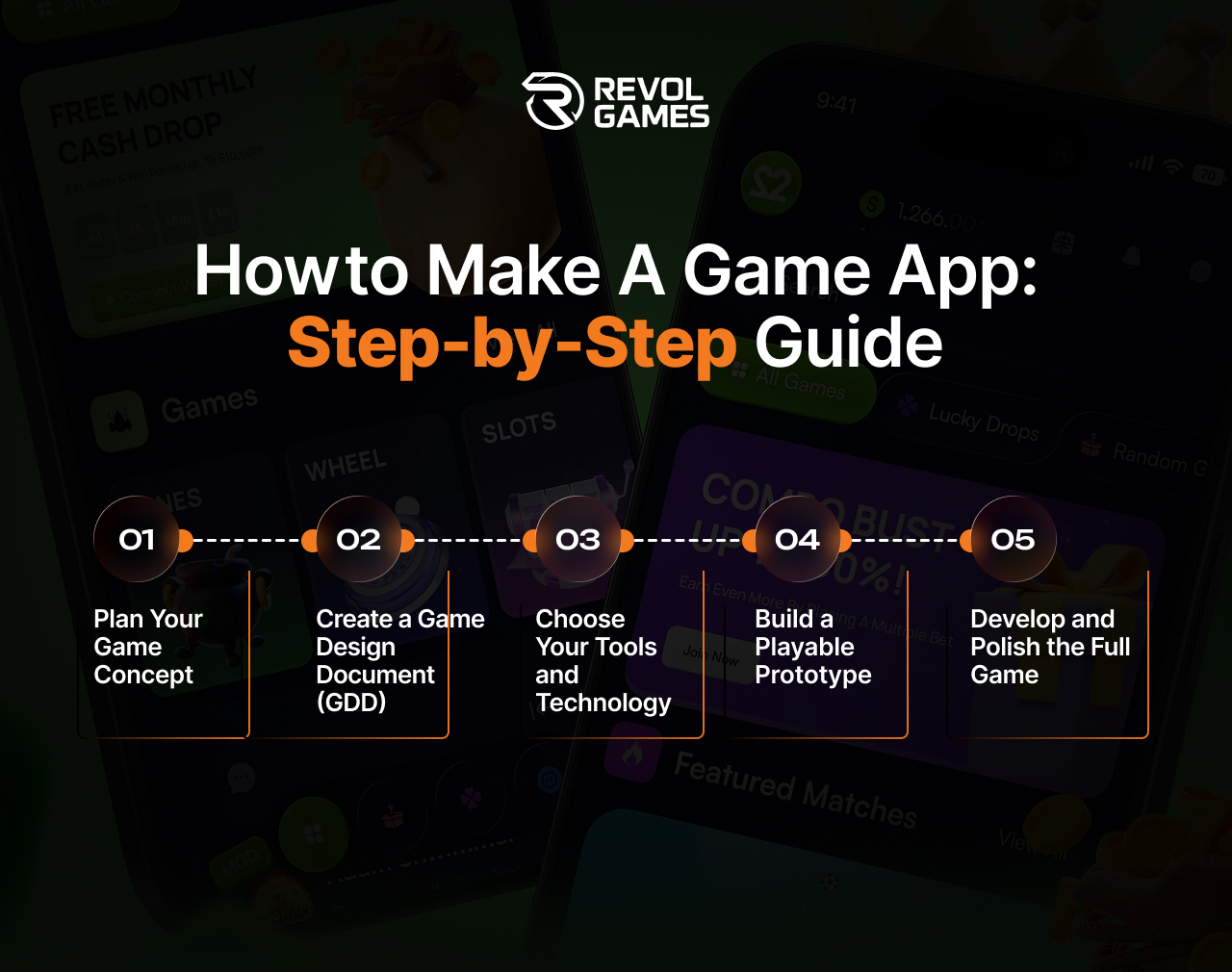
Creating a game app from the initial stage can be easy if you follow our simple steps. This process will serve as a complete readmap. These steps take you from the very first plan to the app that launches in the App Store.
Want to launch a mobile game that stands out in the App Store?
Step 1: Plan Your Game Concept and Approve It
The game plan is the first step before writing the code. The main question is, what is the definition of your game? What type of game is it, like a runner game, puzzle game, or something else. Draw your concept on paper or use a basic document. What’s the hook – why would someone play your game?
Once you have the concept, validate it. This involves doing market research: seeing which games are currently trending both on Google Play as well as the App Store. Get input from the people who might play your game – these can be friends, family, or a target audience.
Further, according to statista report gaming apps are among the most popular app categories in the United States and have the earning potential to match this status
Making a survey is one way, and if you want, you can also make a very simple prototype (either on paper or with a no-code tool) and ask people to give their opinion. Validation is there to help you not build something that no one wants, and it is an essential step to how to make an app game with a goal.
Step 2: Create a Game Design Document (GDD)
Once you have the idea validated, draft a Game Design Document (GDD) describing your concept. This is your architectural design, and it should contain:
- Game mechanics: rules, controls, objectives
- Character and level design: how many levels, what challenges, how progression works
- Story, art style, and sound: sketches, mood boards, and reference art
- UI/UX design: menus, buttons, player flow
- Monetization plan: Will you feature in-app purchases, ads, or a paid model?
- Technical specs: target platforms (iOS, Android), required performance, device compatibility
The GDD is like a binder with all your materials together, and it is especially helpful if you are a team of people or going to hire others. It really is the core of making a mobile game app in a systematic manner.
Step 3: Choose Your Tools and Technology
This step means that you are figuring out how the game will be done the tech way. There are lots of engines and platforms, each being suitable for different skill levels and types of games:
- Unity: a major choice out of the several engines available. Unity is a strong, adaptable, and can be used for both 2D and 3D.
- Unreal Engine: best for photorealistic graphics; however, the learning curve is higher.
- Godot: fully open source, and is also very light, hence quite suitable for indie developers.
- Non-coding engines/game creators (such as Buildbox): fit the needs of those who wish to create games like Call of Duty without writing code; however, the outcome has to be a real game.
Pick according to your technical skills, the money you have, and how complicated your game is. This is a very important step in the whole figuring-out process of how to make a game app, since the right tool will make the development process quite efficient.
Step 4: Build a Prototype
Building a prototype means creating a very simplified version of your game that contains the core game mechanics. During this period, visual elements can be replaced by a square, a circle, or a simple shape – the emphasis here is on the playability.
- Implement the basic gameplay loop (e.g., jump, collect, avoid)
- Test how the mechanics feel
- Use quick iterations: change, test again, and refine
This prototype helps you iron out the fun factor. Often, what seems good on paper feels different when played. Prototyping is a crucial part of how to make a mobile game app because it lets you fail fast and learn.
Step 5: Develop the Game Properly
Once the prototype works and feels fun, you can move to full development:
- Create final art assets: characters, backgrounds, UI, animations
- Write the game logic: implement features, level progression, scoring, and power-ups
- Integrate sound and music
- Develop menus, settings, and user interface
- Implement the monetization plan: put ads, in-app purchases, or anything you planned into code
Often, teamwork is needed during this phase. Programmers, artists, sound designers, and UI/UX designers may collaborate. This is the stage where you refactor your prototype to a polished, playable version of how to make a game app.
Step 6: Test Thoroughly
Testing is of the utmost importance. Loading up a bug-ridden game in the hope of acquiring your first users is not what you want to do.
- Use real devices for testing: both iOS and Android, various screen sizes, and different performance conditions
- Conduct playtesting: people play your game, and you get feedback on the fun, difficulty, and usability aspects
- Perform QA testing: locate and fix the bugs, check for crashes, memory leaks, or UI issues
- Enhance performance: make sure the game runs smoothly, is quick to load, and uses battery and memory efficiently
Testing allows you to perfect your game and gives you assurance of how to make a mobile game app that users will love and even recommend.
Step 7: Preparing Launch
By clicking on the ‘Publish’ button is not necessary to move on to the next key stage game development. There are some important things:
- Creating your App Store listing: writing a catchy title and description with interactive design icons, and a brief video recording.
- Setting up app Analytics: By keeping track of downloads, retention, along monetization tactics.
- Preparing marketing launch: Crafting social media, press, ads, and a soft launch to bring first users.
- Beta testing: basically, you release the game to a small audience first (via TestFlight or Google Play beta) in order to get feedback and solve any last-minute issues
Your active plan is to provide specific factors to create a game on the App Store that engages real users.
Develop a mobile game that reaches millions of players?
Step 8: Post-Launch Maintenance
While everything seems perfect, your game will be launched with the following factors:
- Performance metrics: Keep tracks using analytics to bring users to the game with popular features.
- User Engagement: Connect with users with surveys, feedback, and social media platforms.
- Refresh games: It allows bug fixes and player retention
- Plus: if things are going well, you can think about adding more platforms, localizing for different markets, or launching seasonal events
The continuous cycle of this iteration is the secret of most games’ survival and growth. That is the component of how to make a game app that works not just as a one-time release but as a living, evolving product.
What are the Different Types of Games You Can Build for Mobile
When deciding on creating a game app, you should first understand what kinds of games for mobiles are not only popular but also viable. The following are some common types of games:
Casual / Hyper-casual Games
Simple game mechanics, easily understood, are often played in short sessions.
- Examples: Infinite runners, tap-based games, simple puzzle games.
- Advantages: quick production, easy product accessibility, and a massive target market.
Puzzle Games
Focus on problem-solving, matching, and reasoning, or using the principles of physics.
- Examples: match-3, block puzzles, brain teasers.
- Advantages: they appeal to a broad audience and bring a good turnover through in-app purchases and ads.
Arcade and Action Games
The gameplay is energetic, and games are performed in real-time, thus players must react quickly.
- Examples: side-scrollers, platformers, and shooting games.
- Advantages: can be fun, may become addictive, and are very attractive visually.
Strategy and Simulation Games
Such games ask for the skills of planning, managing resources, building, and strategy.
- Examples: city-builder, strategy war games, simulation (farming, business).
- Advantages: intricate gameplay, high retention, and monetization by using premium features.
Role-Playing Games (RPGs)
These games usually have a plot, develop the characters, offer quests, and allow the player to level up.
- Examples: turn-based RPGs, action RPGs, gacha games.
- Advantages: user engagement at maximum levels, loyal user base, and monetization through in-app purchases.
Multiplayer / Social Games
Players in these games can communicate with and influence each other through competition or cooperation.
- Examples: battle royale, card games, and social board games.
- Advantages: fast spreading, strong retention, and social features that encourage further interaction.
Educational Games
Such products are created with the main purpose to teach skills either academic, language-related, or any other learning topics.
- Examples: Language intellectual games, trivia.
- Advantages: A Growing market that potentially monetizes with a single purchase.
Now, you must be wondering how to create a mobile game app. Well, don’t worry, it’s your first decision and must influence the design, which monetizes the audience with a successful cross-platform game for mobile.
How RevolGames Assists You in Creating Your Own Mobile Game App
RevolGames provides complete end-to-end support for anyone who wants to learn how to make a game app and launch it successfully. Instead of struggling with technical challenges, you can get expert assistance throughout the development journey.
Here is how RevolGames helps you:
- Concept research and game idea validation
- Custom design, artwork, animation, and assets
- Development using leading game engines
- Game mechanics, levels, and scoring system creation
- Integration of AI-driven game features
- Smooth monetization setup
- Complete testing and debugging
- Launch support for both the Play Store and the App Store
- Post-launch maintenance and updates
RevolGames ensures your mobile game is high quality, scalable, visually appealing, and optimized for global users. Whether you have a basic idea or a fully developed concept, their team helps you turn it into a professional mobile game ready for publishing.
Ready to build a winning game app that succeeds in global markets?
Frequently Asked Questions
On average, a mobile game app may cost from $50,000 to $200,000 for iOS or Android, but games with sophisticated features, well-polished assets, and deep gameplay can run over $1,000,000.
Yes, It is definitely possible to earn $100 a day from ads in mobile games. However, achieving this goal demands commitment and diligent effort to generate the required income.
No, if you team up with a development company like RevolGames, we do the coding and technical stuff so that you can concentrate on the game idea, design, and experience.
Basic games can be done in 2–3 months, and more advanced games would require 6–12 months or more.
Related Posts
Top Game Development Companies in the UK
- Posted by admin on May 6, 2026
- Category : Game Development
UK gaming is booming currently. Enter any studio in London, Manchester, or Brighton, and you will find big teams developing…
How to Launch and Market Your Mobile Game After Development
- Posted by admin on May 6, 2026
- Category : Game Development
Every year, more than 500,000 new mobile games hit the App Store and Google Play combined. Of those, fewer than…
How Much Does Unity Game Development Cost
- Posted by admin on March 25, 2026
- Category : Game Development
The best part about making a Unity game is that, for indie developers, small and large gaming companies, they need…